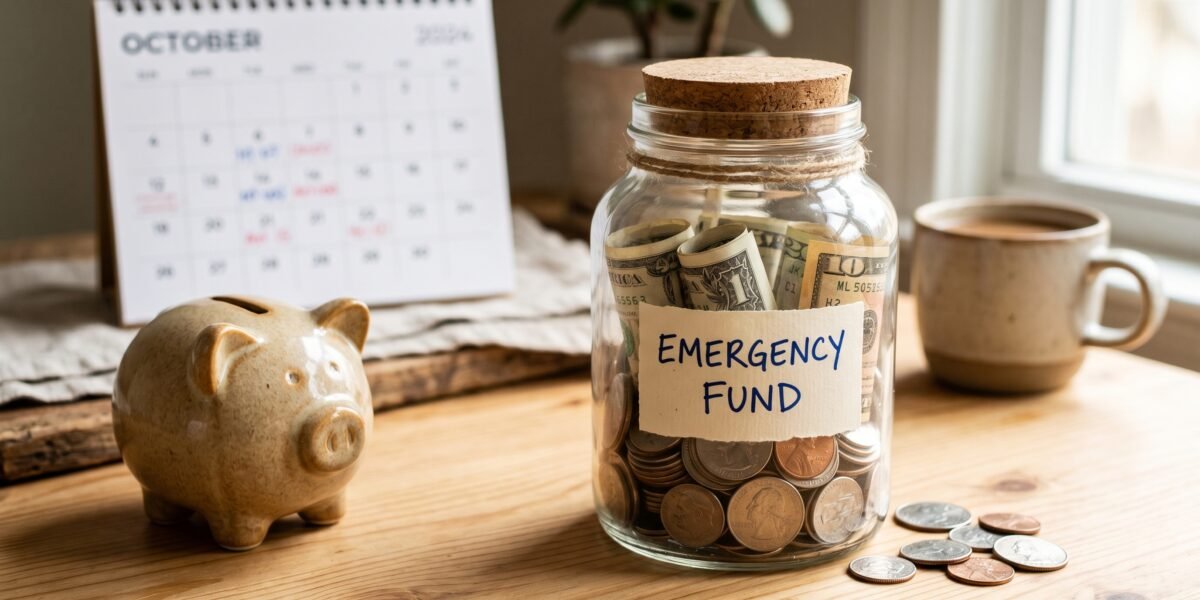
Have you ever had your car break down, a medical bill arrive out of nowhere, or an appliance decide to quit on the worst possible week — and that sick, sinking feeling hits your stomach before you’ve even looked at your bank balance? That feeling has a name. It’s called financial fragility, and it lives rent-free in the lives of millions of people who are doing everything right by every other measure.
Building an emergency fund when money is tight feels a little like being told to save water while you’re already thirsty. But here’s what I’ve learned after years of studying personal finance, testing strategies, and talking to people in genuine financial stress: the goal isn’t to build a perfect fund instantly. The goal is to build something — anything — that puts a cushion between you and the next crisis. We’re going to walk through exactly how to do that, step by step, even if your income is stretched thin and your budget leaves almost no room to breathe.
Key Takeaways
- Even $500–$1,000 creates a meaningful buffer against common financial emergencies.
- Where you keep your emergency fund matters — a separate high-yield savings account reduces temptation and earns interest.
- Automating small contributions is more powerful than large, irregular deposits.
- Mental blocks around saving are normal and addressable — reframing your mindset is part of the process.
- A structured 30-day starter savings challenge can help you build momentum without overhauling your budget.
- You can build an emergency fund while paying off debt — they are not mutually exclusive goals.
Why an Emergency Fund Feels Impossible — And Why It Isn’t
Let’s be honest about the starting point here. If you’re living paycheck to paycheck, the idea of setting aside money for “someday” can feel genuinely absurd. There’s a reason most financial advice feels disconnected from real life — it’s often written from a position of moderate comfort for people who already have a little slack in their budget.

The Paycheck-to-Paycheck Trap
When every dollar is already spoken for, saving feels mathematically impossible. But the trap isn’t always purely numerical. Research consistently shows that financial scarcity creates a cognitive load — a mental bandwidth drain — that makes it harder to plan ahead. You’re not bad at saving. You’re operating under conditions that make forward thinking genuinely harder.
Understanding that distinction is the first small win. It shifts the conversation from “what’s wrong with me” to “what system can I build to make this easier.”
The All-or-Nothing Mindset
Most people abandon the idea of an emergency fund because the recommended target — three to six months of expenses — sounds like an unreachable mountain from where they’re standing. If your monthly expenses are $2,800, being told you need $8,400 to $16,800 saved doesn’t motivate you. It paralyzes you.
The fix is simple in theory but transformative in practice: ignore the final target for now. Your first goal is $500. That’s it. Just $500. That single amount covers most minor emergencies — a car repair, an urgent medical copay, a busted appliance. It’s not the whole staircase. It’s just the first step.
The Debt vs. Savings Dilemma
One of the most common questions I hear is, “Should I pay off debt first or build savings?” The answer isn’t either/or. I recommend a split approach: build a small starter emergency fund of $500–$1,000 first, then direct most of your extra cash toward debt repayment using a clear step-by-step plan to get out of debt. Once your high-interest debt is cleared, you build the full fund. Without that starter buffer, every unexpected expense just gets charged back to the credit card you’re trying to pay off — and you’re running in circles.
How Much Should You Actually Save for an Emergency Fund?
This question — how much should I save for an emergency fund — deserves a real, layered answer rather than a one-size-fits-all rule. The classic “three to six months of expenses” guideline was designed for people with stable income, no debt pressure, and relatively predictable expenses. That’s a specific profile, not a universal one.
The Tiered Emergency Fund Framework
Rather than one giant goal, think in tiers. Each tier gives you a win, a breath of relief, and a reason to keep going.
- Tier 1 — Micro Buffer ($250–$500): Covers small emergencies. Prevents you from going into debt over minor disruptions.
- Tier 2 — Starter Fund ($1,000): The psychological and practical sweet spot for most tight-budget households. Handles most car, home, or health surprises.
- Tier 3 — One Month Cushion: Covers essential bills for 30 days if income drops. This is where real peace of mind begins.
- Tier 4 — Full Fund (3–6 months): The long-term target. Build toward this after high-interest debt is gone.
Progress through these tiers slowly and steadily. Celebrating each tier completion is not optional — it’s part of maintaining momentum.
Adjusting the Target Based on Your Situation
If your income is irregular — freelance work, gig economy, seasonal employment — lean toward six months or more. If you have dependents, a chronic health condition, or a single income household, your buffer needs to be larger. If you have a stable salaried job with solid employer benefits, three months may genuinely be enough.
The math matters, but so does your specific life context. A fund that makes you feel secure is more valuable than one that hits an arbitrary number.
| Household Situation | Recommended Target | Priority Level |
|---|---|---|
| Stable salary, no dependents | 3 months expenses | Medium |
| Single income household with dependents | 4–6 months expenses | High |
| Freelance / irregular income | 6+ months expenses | Very High |
| Currently paying off high-interest debt | $1,000 starter fund first | Immediate |
| Dual income, stable jobs | 3 months expenses | Medium |
Where to Keep Your Emergency Fund
This might sound like a minor detail, but where you park your emergency fund is almost as important as how much you save. The wrong account can either drain your savings through temptation or lose ground to inflation faster than it grows.
The Case for a Separate High-Yield Savings Account
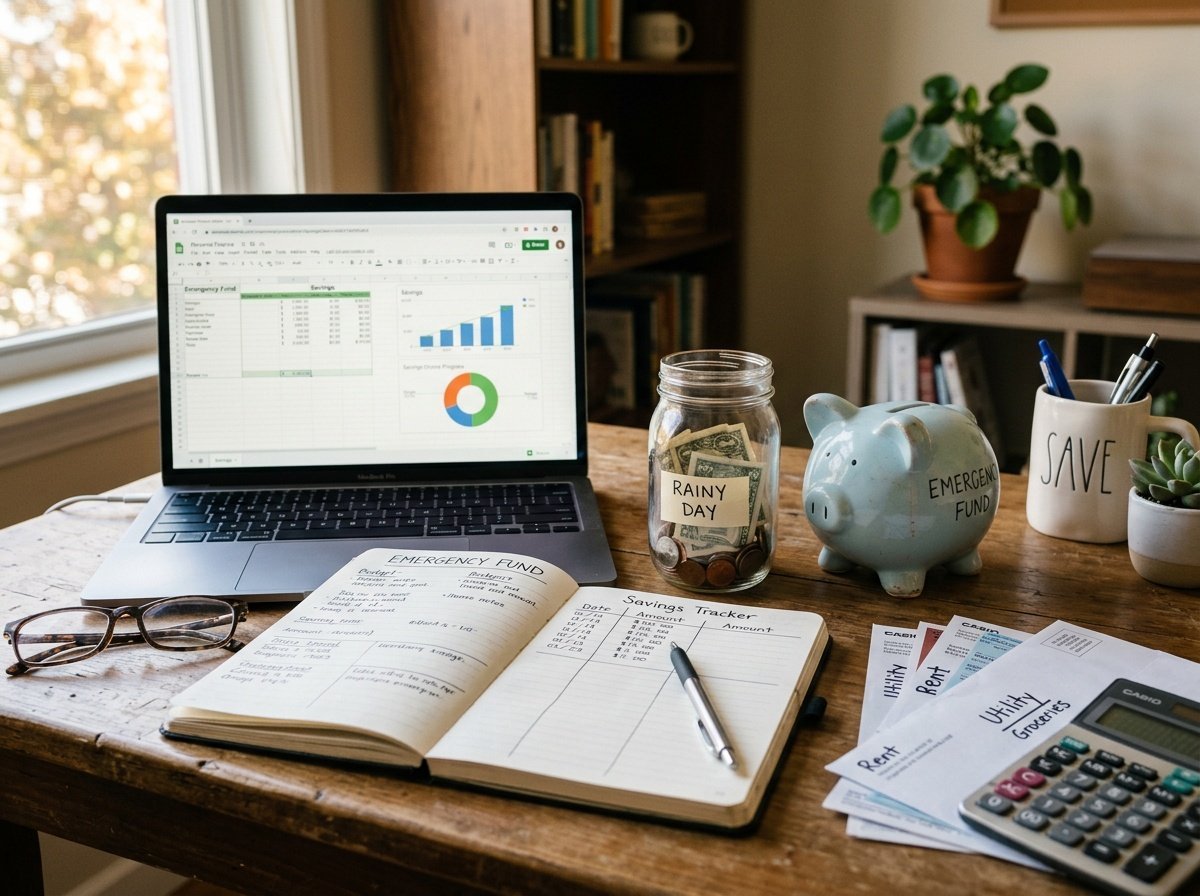
The golden rule: keep your emergency fund completely separate from your everyday checking account. Mixing them makes it too easy to spend. Out of sight really does mean out of mind when it comes to protecting savings from your own spending impulses during a tough week.
A high-yield savings account (HYSA) is the ideal home for your emergency fund. Online banks like Marcus by Goldman Sachs, Ally, and SoFi regularly offer interest rates significantly higher than traditional brick-and-mortar banks. On a $1,000 balance, the difference is modest — but it adds up over time, and the principle of your money working even a little harder matters psychologically.
What to Avoid
Don’t lock your emergency fund in a CD (certificate of deposit) or invest it in the stock market. The whole point is accessibility. If your car breaks down on a Tuesday, you need that money available by Wednesday — not in 12 months when a CD matures, and not subject to market timing when stocks are down 15%.
Also avoid keeping it in cash at home. It doesn’t earn interest, it’s a security risk, and it’s far too accessible for casual spending.
Naming Your Account
This sounds almost embarrassingly simple, but it works. Name the account something emotionally loaded — “Freedom Fund,” “Peace of Mind,” “Don’t Touch This.” Most online banks allow custom account nicknames. Seeing that name every time you log in reinforces the purpose and reduces the urge to dip in for non-emergencies.
How to Build an Emergency Fund on a Tight Budget
This is the tactical core of the whole conversation. Building an emergency fund on a tight budget isn’t about finding big windfalls — it’s about engineering a system that captures small amounts consistently without requiring you to think about it constantly.
The Pay Yourself First System
Before you pay a single bill, transfer a small amount to your emergency fund. Even $10 or $15. The traditional budgeting advice of “save what’s left” almost never works because there’s rarely anything left. Flipping the order — saving first, then spending what remains — is the single most effective shift you can make.
Set up an automatic transfer on payday, even if it’s small. Automation removes the decision entirely. You’re not relying on willpower or discipline every two weeks. The system does it for you.
Finding Money You Didn’t Know You Had
I’m not going to tell you to skip lattes. That’s both condescending and mathematically useless. But there are real pockets of money in most budgets that can be redirected without meaningful lifestyle impact:
- Subscriptions you forgot about (the average household has 3–4 unused subscriptions)
- Lowering one utility bill through a quick negotiation or rate audit
- Selling items you haven’t used in over a year — furniture, electronics, clothing
- Redirecting tax refunds or work bonuses directly to savings before they touch your checking account
- Rounding up purchases using apps like Acorns or Chime’s automatic round-up feature
None of these are revolutionary. But combined, they can generate $50–$150 per month that wasn’t part of your original budget math.
Earning More to Save More
Sometimes the budget genuinely has no more slack to give. In those cases, the path forward is income. A small side income stream — even $100–$200 extra per month — directed entirely toward your emergency fund can have you at your Tier 2 goal in six months or less. If you’re exploring ways to generate additional income, looking into the best digital products to sell online for passive income in 2026 is a surprisingly accessible starting point that doesn’t require much upfront investment.
“The emergency fund isn’t something you build when you have extra money. It’s something you build so that one day you will.”
Automating Your Savings on a Small Income
Automation is the single most underrated tool in personal finance, especially for people managing tight margins. When saving requires an active decision every paycheck, it competes with every other financial priority fighting for attention that week.
Setting Up Automatic Transfers
Most banks and credit unions allow you to schedule recurring transfers between accounts. Set yours to trigger the same day as your paycheck deposit — or the day after, to ensure the funds have cleared. Start with whatever amount feels painless. Seriously, $10 is fine. You can increase it once it becomes invisible to your budget.
If your employer offers direct deposit splitting, use it. You can direct a fixed dollar amount to your savings account automatically before the rest hits your checking account. That money never enters your daily spending flow — which means it never gets spent.
Apps and Tools That Help
Several fintech tools are built specifically around low-friction micro-saving:
- Chime: Automatically rounds up transactions and saves the difference. Also offers a save-when-you-get-paid feature.
- Digit: Analyzes your spending and moves small, safe-to-save amounts into a separate account automatically.
- Qapital: Lets you create rules for saving — “save $5 every time I don’t order takeout” type of behavioral triggers.
- Ally Bank: Their buckets feature within a HYSA lets you organize savings goals visually within one account.
You don’t need all of them. Pick one that matches how you think about money and let it run quietly in the background.
Overcoming the Mental Blocks Around Saving
Financial behavior is as much psychology as math. If it were purely math, everyone who understood compound interest would have a full emergency fund already. The emotional dimension of money — shame, scarcity thinking, avoidance, hopelessness — is real and deserves to be addressed directly.
Reframing What Saving Means
Most people frame saving as deprivation — as denying themselves something today. Try reframing it as buying future safety. Every dollar in your emergency fund is a small insurance policy against future panic. You’re not giving money away. You’re purchasing options and breathing room.
That mental shift sounds small, but it changes the emotional charge of the behavior. Saving feels like gaining something, not losing it.
Dealing With Past Financial Trauma
Financial trauma is more common than most people admit. Growing up in a household where money was constantly scarce, experiencing a bankruptcy or job loss, carrying debt shame — these experiences can create subconscious resistance to saving. “Why bother, something will always take it away anyway.”
If that voice sounds familiar, it’s worth naming it. That belief was formed in a real context, but it doesn’t have to govern your future decisions. A small emergency fund that you protect carefully, even once, begins to rewrite that narrative.
The Permission to Start Small
You have explicit permission to start with $5 a week. I mean that without any sarcasm or condescension. $5 a week is $260 a year. That’s over halfway to your Tier 1 goal just from one small habit. Starting small is not a consolation prize. It’s a strategy.
The 30-Day Emergency Fund Starter Challenge
If you need a concrete, contained starting point, here’s a challenge I’ve put together that takes the abstract concept of “build an emergency fund” and turns it into a month of specific, daily-sized actions. The goal isn’t to save $1,000 in 30 days — it’s to build the habit, identify your saving capacity, and finish the month with real money set aside.

The Challenge Structure
- Week 1 — Audit and Set Up: Review your subscriptions, open a separate HYSA, and set up an automatic transfer of whatever you can afford — even $10.
- Week 2 — Find Hidden Cash: Identify and sell one unused item. Apply the proceeds directly to your new fund.
- Week 3 — Redirect and Reduce: Cut or pause one recurring expense for the month. Transfer that saved amount to your fund.
- Week 4 — Stack and Commit: Calculate what you’ve saved, increase your automatic transfer by just $5 or $10, and commit to keeping the new number running after the challenge ends.
At the end of 30 days, most people who follow this find they’ve saved somewhere between $75 and $300 without dramatically changing their lifestyle. More importantly, the habit is installed. The automatic transfer is running. The account exists. That’s the real victory.
Tracking Your Progress
Progress visibility matters. Whether you use a simple notes app, a spreadsheet, or a visual tracker you print and tape to your fridge — seeing the number grow creates positive feedback that reinforces the behavior. Don’t skip this step. The psychological reward of watching your fund grow, even slowly, is a genuine motivator.
Staying Consistent When Life Gets Messy
Real life doesn’t cooperate with savings plans. Emergencies hit before the fund is built. Income drops. Unexpected expenses derail momentum. This is not a failure — it’s just life doing what life does.
What to Do When You Have to Use the Fund
This might feel obvious, but it’s worth saying clearly: using your emergency fund for an actual emergency is not a failure. That’s exactly what it’s for. The only rule is that after you use it, you rebuild it. Restart the automatic transfer. Go back to whatever tier you were on. Keep moving forward.
The fund being spent and rebuilt three times in a year is still doing its job. It’s still keeping you out of high-interest debt during hard moments. That’s a win, even when it doesn’t feel like one.
Protecting the Fund From Non-Emergencies
One practical safeguard: define “emergency” in advance. Write it down if you have to. A car repair that prevents you from getting to work is an emergency. A sale at your favorite store is not. A medical bill is an emergency. A spontaneous trip because flights are cheap is not — even if it’s technically a good deal.
Having a written definition reduces the number of in-the-moment negotiations you have with yourself, which is when the fund is most vulnerable.
Scaling Up as Income Improves
As your financial situation stabilizes — whether through debt payoff, income growth, or both — revisit your savings rate. Every time something in your budget frees up, direct at least half of it toward your emergency fund until you hit your target tier. This is how the fund moves from “starter” to “full” without requiring a dramatic lifestyle change all at once.
Frequently Asked Questions
How do I start building an emergency fund when I have no extra money?
Start smaller than you think is meaningful. Even $5 or $10 per paycheck transferred automatically to a separate account begins building the habit and the fund simultaneously. Look for one specific thing to cut or sell this month and direct that amount to savings. The goal at first is less about the dollar amount and more about installing the behavior.
Should I build an emergency fund or pay off debt first?
Both, in a specific order. Build a small starter emergency fund of $500–$1,000 first. This prevents you from going back into debt every time something unexpected happens while you’re in repayment mode. Once your high-interest debt is cleared, shift focus to building your full emergency fund. Running both goals in parallel — saving a small amount while attacking debt — is smarter than choosing one exclusively.
How much should I save for an emergency fund on a low income?
Start with one month of essential expenses as your medium-term target, working through the starter tiers first. On a genuinely tight budget, having $500 in a dedicated account is already ahead of most households statistically. The exact amount matters less than having something that prevents you from reaching for a credit card or payday loan during a crisis.
Is a high-yield savings account really necessary for an emergency fund?
Not strictly necessary, but highly recommended. The key requirement is that the account is separate from your everyday spending account — that separation is what protects the money. A high-yield savings account also means your money earns a little while it sits there. Over a few years of building a full fund, the interest difference between a HYSA and a standard savings account becomes genuinely meaningful.
What counts as a real emergency for using the fund?
A real emergency is an unexpected, necessary expense that affects your health, ability to work, or essential housing. Car repairs needed to commute, medical costs, urgent home repairs, and sudden job loss all qualify. Vacations, sales, gifts, and lifestyle upgrades do not — even if they feel urgent in the moment. Writing your personal definition of “emergency” before you need it removes the temptation to rationalize later.
What if I have to use my emergency fund before it’s fully built?
That’s exactly what it’s there for. Use it, breathe, and then rebuild. Restart your automatic transfer the same week if possible. Don’t let using the fund feel like failure — it means the system worked. The goal is to rebuild it as the next priority before moving on to other financial goals.
Can I build an emergency fund and invest at the same time?
Yes, but with a caveat. Prioritize your starter fund ($1,000) before putting extra money into investments. Emergency funds and investment accounts serve completely different purposes — one is for stability, the other is for growth. Using investments as an emergency fund is risky because markets move, and you may need money exactly when values are down. Once your starter fund is solid, you can absolutely run both goals in parallel.
Building an emergency fund when money is tight is one of the most genuinely hard things in personal finance — not because the math is complicated, but because it requires hope and patience at the exact moments when both feel scarce. But the people I’ve seen transform their financial lives didn’t do it with one big move. They did it with small, consistent decisions that compounded over time into something that changed how they feel every single day. Start with $500. Open a separate account today. Set up one automatic transfer for whatever you can manage this week. That’s the whole assignment for right now. The rest builds from there — and I’m here for every step of it.