
Have you ever looked at your schedule and thought, there has to be a smarter way to earn money than trading every single hour for a paycheck? Maybe you’re a stay-at-home mom trying to contribute financially without sacrificing family time, or a professional tired of watching your earning potential flatline at forty hours a week. That tension is real, and it’s pointing you toward something worth exploring.
In this post, we’re diving deep into the world of digital products to sell online — one of the most accessible, beginner-friendly paths to building passive income that exists right now. We’ll cover exactly what to create, where to sell it, what kind of money you can realistically expect, and how to get started without spending a fortune upfront.
Key Takeaways
-
Digital products require zero inventory, no shipping, and can be sold infinitely — making them one of the highest-margin passive income vehicles available.
-
Templates, printables, presets, courses, and swipe files are among the most profitable and beginner-friendly options in 2026.
-
Platforms like Etsy, Gumroad, Teachable, and Shopify each serve different sellers — choosing the right one matters for long-term growth.
-
Realistic income ranges from a few hundred dollars monthly as a side stream to thousands once you build a catalog and audience.
-
You can start creating and selling digital products with free tools like Canva, Google Docs, and Notion — zero budget required.
-
The biggest competitive advantage isn’t having a massive following — it’s solving a specific problem for a specific person.
Why Digital Products Are One of the Best Passive Income Plays in 2026
Before we get into the product types, let’s talk about why this model keeps appearing at the top of every legitimate passive income conversation. The economics are genuinely hard to argue with.
The Create-Once-Sell-Forever Advantage
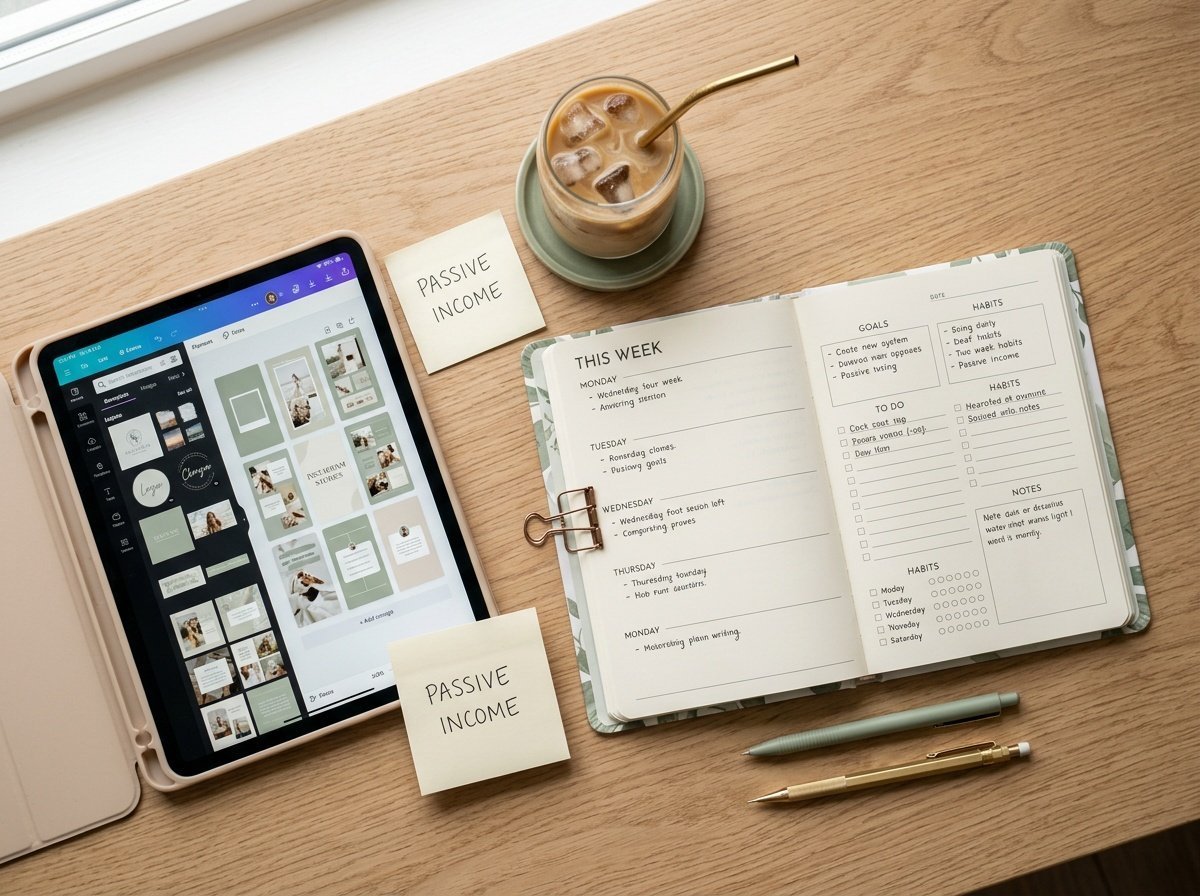
Physical products require restocking, warehousing, packaging, and shipping. A service business requires your time every single time money changes hands. Digital products break both of those rules. You build the thing once — a PDF guide, a Canva template, an online course — and the file delivers itself to buyers automatically, whether you’re cooking dinner, sleeping, or road-tripping with your kids.
That structure isn’t just convenient. It fundamentally changes what’s possible when you think about building scalable income streams around your lifestyle. One product in your shop can generate revenue for years without modification.
Why Beginners Succeed Here
The barriers to entry are unusually low. You don’t need startup capital, a business degree, or a warehouse. You need a skill, a tool (often free), and a platform. That’s why digital products work especially well for stay-at-home parents, side hustlers, and anyone who wants to build something real without gambling their savings on it.
In 2026, the tools have gotten even more accessible. AI writing assistants, drag-and-drop design platforms, and no-code course builders mean the technical wall that used to block people is essentially gone. The competitive edge now belongs to whoever solves the most specific problem most clearly.
The Best Digital Products to Sell Online Right Now
Not all digital products are created equal. Some saturate quickly, some hold value for years, and some punch above their weight in terms of price point versus effort. Here’s a practical breakdown of the categories worth your attention.
Templates: High Demand, Low Creation Time
Templates are pre-built frameworks that buyers customize for their own use. Think Canva social media templates, resume templates, budget spreadsheets, Notion dashboards, business proposal decks, or email newsletter layouts. The market for these is enormous because everyone wants professional results without starting from scratch.
What makes templates especially smart as a beginner product: you’re probably already creating them informally. If you’ve built a budgeting spreadsheet you love, a clean email signature, or a project tracker in Notion — that’s a product. Package it properly and price it right, and you’re in business.
Printables: The Evergreen Etsy Staple
Printables are downloadable files buyers print at home — planners, wall art, checklists, wedding invitations, kids’ activity sheets, meal planners, affirmation cards. Etsy has made this category a legitimate income stream for thousands of sellers, and it continues to grow.
The sweet spot for printables is the intersection of utility and aesthetics. A beautiful weekly planner that also solves a real organizational problem will outsell a generic one every time. If you have any eye for design, this is one of the fastest paths to your first digital sale.
Online Courses and Mini-Courses
Online courses carry the highest price points in this space. A well-structured course on a niche topic can sell for anywhere from $27 for a mini-course to $497 or more for a comprehensive program. If you have expertise — even as a hobbyist — there is almost certainly an audience willing to pay you to teach it.
Don’t let the word “course” intimidate you into thinking you need a studio setup and Hollywood production values. Some of the most profitable courses are simple screen recordings, slide decks with voiceover narration, or even beautifully formatted PDF workbooks. Start lean. Sell first, refine later.
Presets and Digital Design Assets
Presets — specifically Lightroom photo editing presets — have been a consistent bestseller for photographers and content creators. But the broader category of digital design assets includes Procreate brushes, Photoshop actions, font bundles, icon sets, and UI kits. If you work in any visual creative field, you already have the ingredients for a product.
Swipe Files, Toolkits, and Done-for-You Resources
Swipe files are collections of ready-to-use content — email sequences, social media captions, sales page copy, cold pitch templates, blog post prompts. They sell well because people will pay to skip the blank-page problem. A well-curated swipe file can command $17 to $97 depending on the niche and depth.
Toolkits — bundled collections of templates, guides, and checklists around a specific outcome — often perform even better than individual products because the perceived value is higher and the price justification is easier.
Where to Sell Digital Products: Platform Comparison
Choosing where to sell is one of the most important early decisions you’ll make, and the good news is that it doesn’t have to be permanent. Let’s look at the major platforms honestly.

|
Platform |
Best For |
Fees |
Built-in Traffic |
|---|---|---|---|
|
Etsy |
Printables, templates, design assets |
$0.20 listing + 6.5% transaction |
Yes — massive marketplace |
|
Gumroad |
Swipe files, PDFs, courses, bundles |
10% on free plan, lower on paid |
Minimal — you drive traffic |
|
Teachable |
Online courses, coaching programs |
Free plan available; paid plans from $39/mo |
None — audience-dependent |
|
Shopify |
Building your own branded store |
From $39/mo + transaction fees |
None — you drive traffic |
|
Payhip |
Beginners, low-cost entry |
5% on free plan |
Minimal |
Starting on Etsy: The Beginner’s Fastest Path to Traffic
Etsy remains the single best starting point for most beginners creating printables and templates. The platform has built-in search traffic from buyers who are actively looking to purchase — not just browse. You don’t have to build an audience before you can make a sale, which removes one of the biggest roadblocks new sellers face.
The tradeoff is that Etsy’s fees add up, and you’re competing in a crowded marketplace. Strong SEO in your listing titles and tags, clean mockup images, and competitive pricing are your main levers for standing out early on.
Gumroad and Payhip: Lean, Flexible, Creator-First
If you already have a small audience — even a few hundred followers on Instagram, Pinterest, or a newsletter — Gumroad and Payhip are worth considering because they give you more control over the buyer relationship. You keep the customer email, can run your own promotions, and build a direct line of communication that Etsy doesn’t offer.
Teachable and Shopify: When You’re Ready to Scale
These platforms make the most sense once you have proof of concept and want to invest in a more professional infrastructure. Teachable’s course builder is genuinely excellent, and Shopify gives you total brand control. Neither is necessary at the beginning, but both become valuable as your catalog and revenue grow.
Realistic Income Expectations for Passive Income with Digital Products
Let me be straight with you here, because too many people enter this space with either wildly inflated expectations or unnecessary pessimism. Passive income with digital products is real — but it’s not instant, and the math takes time to compound.
What Beginners Typically Earn in Year One
Most beginners selling printables or templates on Etsy earn somewhere between $50 and $500 per month within their first six to twelve months, depending on how many products they list, how well they research demand, and how consistently they optimize their listings. That’s not glamorous, but it’s also not nothing — and it’s compounding quietly in the background.
The sellers who cross the $1,000 per month threshold reliably are usually those who have built a catalog of fifteen or more products, understand Etsy SEO, and have begun driving some external traffic from Pinterest or social media.
The Course and High-Ticket Product Tier
Online courses change the income math significantly. A single $97 course sold five times a month is nearly $500 from one product. Sold twenty times? That’s close to $2,000. The challenge is that courses require more upfront effort to create and typically need an engaged audience or paid traffic to sell consistently.
The most realistic path is a hybrid model: start with lower-priced digital products to build sales velocity and social proof, then layer in a course or premium toolkit once you understand what your buyers actually want.
“The goal isn’t to launch one perfect product. It’s to build a catalog that compounds — where ten small sales a day from ten different products feels better than white-knuckling one big launch.”
Getting Started With Zero or Low Upfront Investment
One of the most common things I hear from people exploring this space is, “I don’t have money to invest in tools or software.” And my honest response is: you genuinely don’t need it. The free tier of the tools available today is legitimately powerful.
Free Tools That Cover 90% of What You Need
-
Canva (free tier) — design templates, printables, social media assets, workbooks, and pitch decks
-
Google Docs and Google Slides — create swipe files, guides, and presentation-format mini-courses
-
Notion (free tier) — build dashboard templates and organizational systems
-
ChatGPT or other AI writing tools — brainstorm, outline, and draft content faster
-
Gumroad or Payhip (free plans) — host and sell your products immediately
-
Etsy (low-cost listing fees) — $0.20 per listing to get in front of active buyers
This entire stack costs you less than a single listing fee to get started. The investment required is time, intention, and a willingness to learn from your first few sales.
Validating Before You Build
Before spending hours creating a product, spend thirty minutes confirming people want to buy it. Search Etsy for similar products. Look at how many reviews the bestsellers have. Browse Pinterest to see what content gets saved in your niche. Use free tools like how to validate demand before you build to understand what buyers are actually searching for.
Validation is the step most beginners skip, and it’s the reason most beginner products underperform. Build what the market is already asking for, not just what you find interesting to create.
Niche Down to Stand Out: The Specificity Strategy
Here’s one of the most important strategic points in this entire conversation: the sellers who win in digital products are almost never the ones trying to serve everyone. They’re the ones who went narrow and deep on a specific audience.

Why Generalists Get Lost in the Marketplace
“Budget planner printable” is a crowded search term. “Budget planner for single moms managing irregular income” is a specific solution for a specific person. The second one has less competition, speaks more directly to the buyer’s pain point, and commands more emotional resonance — which means higher conversion rates and more loyal customers.
When you choose a niche you can actually live in, you’re not limiting your audience — you’re sharpening your aim. A niche product that perfectly solves one person’s problem will always outperform a generic product that sort-of helps many people.
Finding Your Niche Intersection
The sweet spot is where your skills or knowledge meets a real buyer demand. Ask yourself three questions:
-
What do I know how to do that others often ask me about?
-
What communities am I already part of that have spending habits?
-
What problems have I personally solved that others in my situation face?
Your lived experience — as a mom, a teacher, a project manager, a fitness enthusiast, a small business owner — is not irrelevant to this process. It’s often your most valuable differentiator.
Building a Simple Marketing System Without an Existing Audience
“But I don’t have followers” is the most common objection I hear from people who are otherwise ready to start. And it’s a real consideration, but it’s not a dealbreaker — especially if you approach marketing strategically rather than desperately.
Pinterest as a Long-Game Traffic Engine
Pinterest is, in my opinion, one of the most underrated traffic sources for digital product sellers in 2026. It functions more like a search engine than a social platform, which means the content you pin today can generate clicks and sales twelve to eighteen months from now. For Etsy sellers especially, the Pinterest-to-Etsy traffic funnel is well-documented and genuinely effective.
You don’t need thousands of followers on Pinterest to get traction. You need consistent, well-designed pins with keyword-rich descriptions pointing at your listings. Start with five to ten pins per week and build from there. It’s a slow burn that pays dividends.
Building a Micro Email List From Day One
An email list is the most durable marketing asset you can build. Unlike social media platforms that change their algorithms or shut down accounts, an email list belongs to you. Even a list of three hundred engaged subscribers can reliably drive sales when you launch a new product.
Start building yours immediately, even before your first product is finished. Offer a free mini-resource — a one-page checklist, a small template, a quick guide — in exchange for an email address. Platforms like building a simple email list from day one make this setup simple and often free at small subscriber counts.
Common Mistakes New Digital Product Sellers Make
I’d rather have this conversation now than let you discover these the hard way six months in. None of these mistakes are fatal, but they do cost time and momentum.
Waiting for Perfect Before Launching
Perfectionism is the most expensive hobby in the digital product world. A solid product launched today will always generate more data, feedback, and income than a perfect product launched never. Your first version doesn’t need to be your final version — it just needs to deliver genuine value and look clean enough to justify the price.
Underpricing Out of Insecurity
New sellers consistently underprice their products, especially when they’re nervous about whether anyone will buy. But price signals quality. A $3 Canva template gets treated like a $3 template. A $17 template gets taken more seriously, used more intentionally, and reviewed more generously. Price based on the value and outcome you’re delivering, not on the number of hours it took you to make.
Building Without Validating
We touched on this earlier, but it deserves reinforcement: spend time in buyer communities, search the platforms you plan to sell on, and look for proven demand before investing serious time in creation. The market will tell you what it wants if you ask the right questions.
Stopping After One or Two Products
This is a catalog game. One product rarely changes anyone’s financial picture. Fifteen products, each making modest but consistent sales, absolutely can. Treat your first few products as research and learning experiences, not make-or-break tests. Momentum builds through volume and iteration.
Frequently Asked Questions
What are the best digital products to sell online for beginners?
Printables and templates are typically the easiest starting point because they require no technical setup, can be created with free tools like Canva, and sell well on established marketplaces like Etsy. From there, swipe files, toolkits, and mini-courses are natural next steps as you build confidence and understand what your specific audience needs.
How much can you realistically earn from passive income with digital products?
Most beginners earn between $100 and $500 per month within their first year, depending on the size of their product catalog, their niche selection, and how actively they drive traffic. Sellers with fifteen or more products, strong SEO, and consistent Pinterest or social media marketing can realistically reach $1,000 to $3,000 per month over time. There is no ceiling — but there is a ramp-up period.
Do I need design experience to create digital products?
Not at all. Canva’s free tier gives complete beginners access to professional-quality templates they can customize and resell (within Canva’s license terms). Many bestselling printables are simple, clean designs rather than elaborate artwork. Clarity and usefulness matter far more than visual complexity when it comes to what actually sells.
Is Etsy still a good platform for selling digital products in 2026?
Yes — Etsy remains one of the most beginner-friendly platforms for digital product sellers because of its built-in marketplace traffic. Buyers actively search Etsy for printables, planners, templates, and design assets, which means you don’t need an existing audience to make your first sales. The fees are manageable and the learning curve is relatively gentle.
How do I protect my digital products from being stolen or shared illegally?
No system is completely theft-proof, but platforms like Gumroad and Etsy include purchase verification and limit download access to verified buyers. You can also add copyright notices to your files, use PDF password protection for sensitive products, and watermark preview images. Most buyers are honest, and the small percentage of bad actors rarely justifies slowing down your selling process.
Can stay-at-home moms realistically build income selling digital products?
Absolutely — and this model is particularly well-suited to parents with limited working hours. The beauty of digital products is that the creation work happens in concentrated blocks of time, while the sales happen automatically around the clock. Many sellers build profitable Etsy shops or product libraries during nap times, evenings, or early mornings. You don’t need full-time hours to build part-time income here.
What is the fastest way to make your first digital product sale?
Open an Etsy shop, create one printable or template in Canva that solves a specific, searchable problem, write an SEO-optimized listing title and description, use a clean mockup image, and price it between $5 and $15. Then create three to five Pinterest pins linking to the listing. This entire process can be completed in a weekend, and many beginners make their first sale within two weeks of going live.
Building income around digital products isn’t a shortcut — but it is one of the most intelligent uses of limited time I’ve come across for people who want more financial flexibility without trading more hours for dollars. Start with one product, in one niche, on one platform. Learn from it. Add another. The catalog compounds quietly until one day you check your phone and realize sales happened while you were doing something that actually mattered to you. That’s the version of financial freedom worth building toward — and you have everything you need to start today.