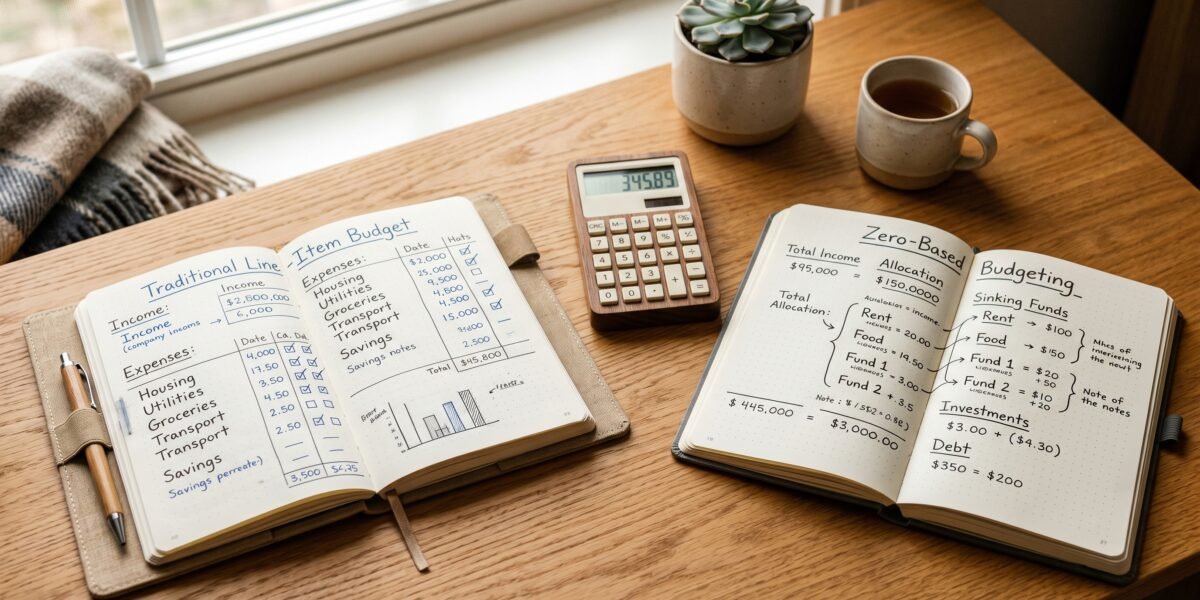
Most budgeting debates come down to two philosophies. One says account for every single dollar on purpose. The other says set a few limits and stop sweating the rest. Neither is “correct” — they suit different people and different seasons of life. Here’s how to tell which one fits you right now, plus a side-by-side example so you can see exactly how the same paycheck gets handled differently under each.
What Zero-Based Budgeting Is
In a zero-based budget, your income minus your assignments equals zero — every dollar gets a job before the month begins. Not because you spend it all, but because “savings” and “extra debt payoff” are jobs too. If you bring home $3,800, you assign all $3,800: bills, groceries, fun, savings, debt, until there’s nothing left unlabeled.
The power is intentionality. Nothing slips through the cracks, because there are no cracks — every dollar is accounted for on purpose. It’s the method behind apps like YNAB and the envelope system.
If you want to try the envelope method without building your own system, a simple budget binder with zipper cash envelopes — like this one — makes it easy to get started for under $10. (As an Amazon Associate, I earn from qualifying purchases. See our affiliate disclosure.)
- Strengths: maximum awareness, great for paying off debt or saving aggressively, exposes wasteful spending fast.
- Trade-offs: more time and attention, can feel intense, requires re-planning each month as income or expenses change.
What Traditional Budgeting Is
Traditional budgeting sets target limits for major categories — housing, food, entertainment, savings — and lets you operate within them without tracking every dollar to zero. The 50/30/20 rule is the most popular version: three broad buckets, minimal upkeep.
- Strengths: simple, low-maintenance, easy to sustain for years, hard to burn out on.
- Trade-offs: less granular, easier for small leaks to go unnoticed, slower to surface waste.
A Worked Example: $3,800 Take-Home, Two Ways
Numbers make the difference between these two methods concrete in a way definitions can’t. Here’s a hypothetical household bringing home $3,800 a month, budgeted first the zero-based way and then the traditional way. This is an illustrative example only — not a personal budget or a recommendation for your numbers, which will depend on your city, family size, and debt load.
The zero-based version: every dollar named
Every one of the $3,800 gets assigned to a specific line before the month starts:
- Rent: $1,200
- Utilities: $150
- Groceries: $450
- Car payment, gas, and insurance: $400
- Minimum debt payments: $300
- Extra debt payoff: $200
- Emergency fund: $150
- Retirement or other savings: $200
- Subscriptions: $40
- Dining out and entertainment: $200
- Personal spending: $300
- Clothing and miscellaneous: $110
- Car maintenance and gifts sinking fund: $100
That’s thirteen separate assignments adding up to exactly $3,800 — nothing left unlabeled, including the $150 going to the emergency fund and the $200 in extra debt payoff. If income shifts or a bill runs higher than expected, the whole sheet gets rebalanced before the month is over.
The traditional version: a few broad caps
Using a 50/30/20-style split, the same $3,800 gets sorted into three buckets instead of thirteen lines:
- Needs — $1,900 (50%): rent, utilities, groceries, transportation, and minimum debt payments all draw from this one cap.
- Wants — $1,140 (30%): dining out, subscriptions, entertainment, and personal spending all draw from this one cap.
- Savings and extra debt payoff — $760 (20%): emergency fund, retirement contributions, and extra debt payments all draw from this one cap.
As long as spending in each bucket stays under its cap, nothing needs to be tracked line by line. The trade-off is visibility: because the 30% “wants” bucket isn’t itemized, subscription creep or a few extra takeout orders can eat into it for months unnoticed — exactly the kind of leak cutting your monthly expenses is built to catch. And because the 20% bucket lumps savings and debt payoff together, you decide how to split that $760 as you go, rather than committing to it upfront the way the zero-based version does.
How to Choose
Lean zero-based if you’re attacking debt, saving for a big goal, trying to figure out where your money keeps disappearing, or you simply enjoy being hands-on. The extra effort pays off fastest when you’re trying to change your finances, not just maintain them.
Lean traditional if your finances are stable, you value simplicity, you’ve burned out on detailed budgets before, or you have an irregular schedule that makes daily tracking unrealistic. It’s the method most likely to survive a busy, ordinary life.
You Can Switch — and Probably Should
These aren’t permanent identities. A smart approach is to run a zero-based budget for two or three months when you want to reset — it’s the fastest way to find leaks and break bad habits — then relax into a traditional 50/30/20 system once things are under control and you just need to maintain.
The best budget isn’t the most rigorous one. It’s the one matched to what you’re trying to accomplish right now — and the one you’ll actually keep doing. Start with whichever fits your current season, and don’t be afraid to change methods when the season changes.
Which One Should You Actually Pick?
Past the definitions, two practical questions tend to settle it faster than anything else.
How steady is your income? A paycheck that’s the same every two weeks keeps traditional budgeting’s caps accurate with almost no maintenance. Income that moves — tips, commission, freelance or side-hustle work, seasonal hours — already forces you to re-plan every month just to know what you’re working with, so you might as well do it the zero-based way and get the extra visibility for the same effort. If money is tight enough that most of your income is spoken for before you start, the category math matters less than covering essentials first — budgeting on a low income and still saving money walks through that situation specifically.
How hands-on do you actually want to be? Be honest, not aspirational. If you like checking in on your money and adjusting as you go, zero-based budgeting will feel satisfying rather than tedious. If budgeting is a chore you’re trying to survive, the fewer decisions a system asks of you each week, the longer you’ll keep using it — a system you abandon in month three doesn’t beat a simpler one you’re still running at month twelve.
Frequently Asked Questions
Is zero-based budgeting more effective than traditional budgeting?
Not universally — it depends what you’re solving for. Zero-based budgeting surfaces exactly where money leaks, because every dollar has to justify itself before the month starts, which suits a specific job: getting out of debt faster, saving aggressively toward a goal, or diagnosing a budget that never adds up. It isn’t automatically better for sticking with a system for years, since the ongoing upkeep is the trade-off. If “effective” means which one you’ll still be doing in twelve months, traditional budgeting often wins simply by asking less of you.
What’s the difference between a long-term zero-based budget and using it short-term?
A short-term zero-based budget is usually a reset — run it for a few months to find leaks and build awareness, then relax once it’s done its job. A long-term zero-based budget means re-assigning every dollar indefinitely, which tends to fit people with irregular income (the amounts genuinely change each month anyway) or people who enjoy the process. On a steady paycheck, running it long-term usually means paying an ongoing time cost for precision you stopped needing after the first few months.
What’s the difference between baseline budgeting and zero-based budgeting?
“Baseline budgeting” is essentially what this article calls traditional budgeting — you set a baseline, or cap, for each broad category based on past spending or a rule like 50/30/20, then operate inside it without re-justifying every dollar. Zero-based budgeting throws out the baseline and starts every month at zero, requiring you to actively assign each dollar a job instead of defaulting to what you spent last time. Baseline approaches drift slowly if your habits do; zero-based approaches catch that drift immediately because you’re rebuilding the plan from scratch every month.
Is ZBB the same thing as zero-based budgeting?
Yes — ZBB is just the abbreviation, and it’s the same idea whether it’s applied to a household budget or, in its original context, to corporate and government budgeting, where every department justifies its entire budget from zero each cycle instead of starting from last year’s number. The personal-finance version works the same way: nothing carries over by default, and every dollar earns its place each month.